Skip to content
Releases

What's new in Tally

Every Tally for QuickBooks release — what it brings, how to install it, and where to learn more. Updates install seamlessly from the AppExchange.

Tally for QuickBooks

v3.91

Reliability Update

· August 2026Latest

Purchase orders now save for everyone on your team, not just administrators — and a purchase order raised in QuickBooks finally reaches Salesforce on its own. Vendor sync covers your whole vendor list, customer deactivation flows both ways, and the saves that used to fail quietly now say exactly what QuickBooks told us.

Install v3.91 Installs from Salesforce · AppExchange managed package
  • Purchase orders save for everyone, not just administrators

    Saving a purchase order wrote its Salesforce copy in a way that quietly demanded administrator-level access to the whole org. Anyone without it — a purchasing manager on a standard profile, or the background job that mirrors purchase orders from QuickBooks — ended up with the order created in QuickBooks, no record in Salesforce, and a message that said only that it could not be saved. Tally no longer needs that elevated access. If you widened someone’s permissions to work around this, you can safely take it back.

    Learn more
  • Purchase orders created in QuickBooks now sync to Salesforce

    A purchase order raised on the QuickBooks side used to stay there — Tally listened for changes to existing orders but skipped brand-new ones, so they never appeared in Salesforce. New purchase orders now come across automatically with their line items, and re-processing the same one can’t create a duplicate.

    Learn more
  • Every vendor syncs, not the first 100

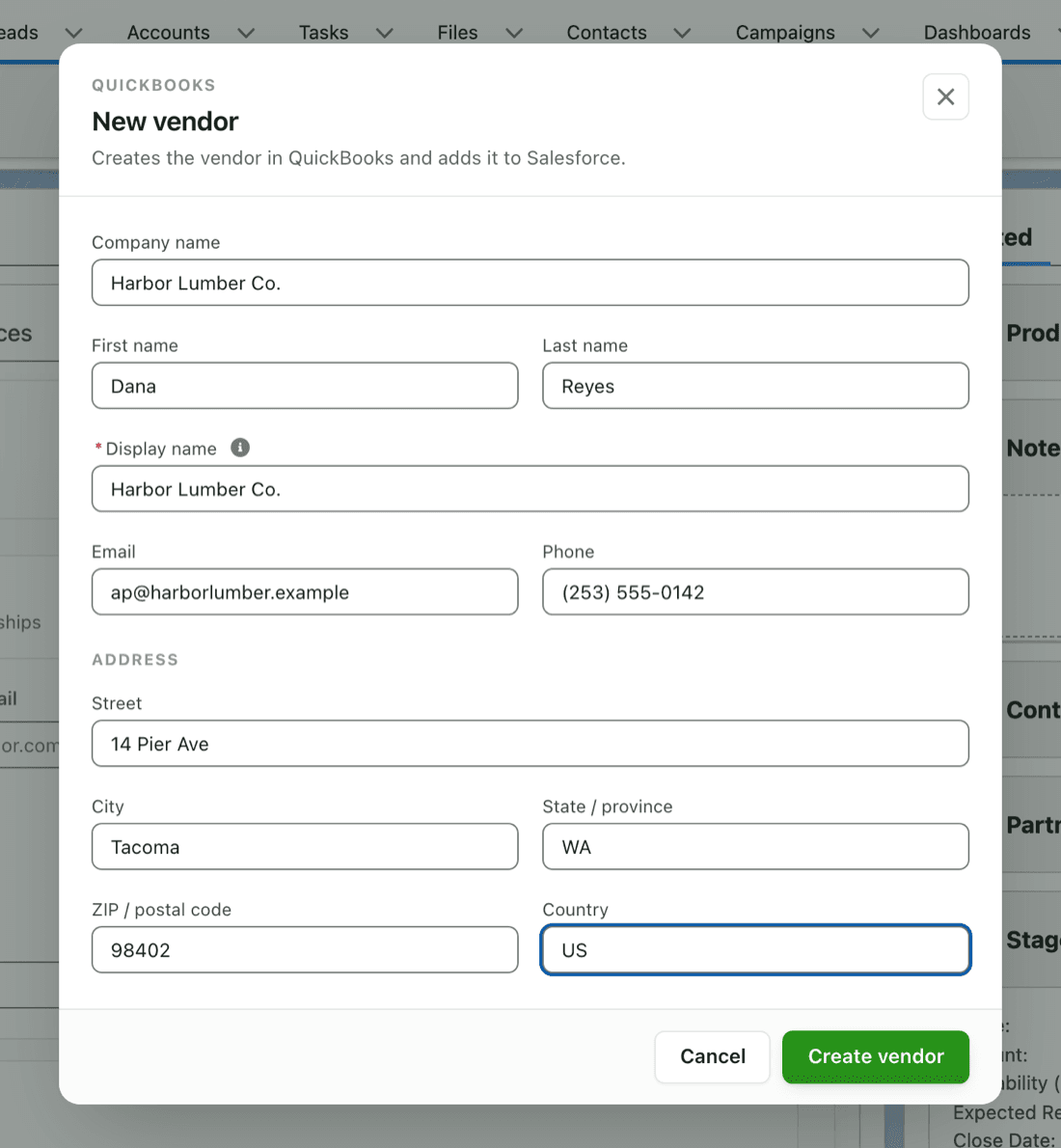
    QuickBooks returns 100 records per request unless you ask for more, and vendor sync wasn’t asking. If your company has more than 100 vendors, the rest were never created or updated in Salesforce — which also meant purchase orders for those vendors couldn’t link correctly. Vendor sync now pages through the full list, and the same fix went into the purchase order sync, so a catch-up run reaches your most recent orders instead of only your oldest.

  • Deactivating a customer works, and so does turning them back on

    Marking a customer inactive in QuickBooks looked like it did nothing on the Salesforce side, and un-ticking then re-ticking Active in Salesforce deactivated the customer but would never reactivate them. Two causes: QuickBooks leaves inactive customers out of the search Tally was using, so a deactivated customer simply couldn’t be found any more; and Tally wasn’t recording the version stamp QuickBooks returns after each write, so the next edit was rejected as out of date — silently. Tally now reads the customer directly by its QuickBooks id, keeps the version stamp, and surfaces a rejection instead of swallowing it. Any automation you have watching the active flag fires as expected.

  • Failed saves say what actually went wrong

    When QuickBooks accepted a purchase order but Salesforce couldn’t save its copy, the message stopped at “could not be saved” and the diagnostic detail was thrown away before anyone could read it. The reason now travels with the message and is written to the integration log, so support can see the cause on the first report instead of asking you to reproduce it. The customer editor also no longer reports success it didn’t get — it shows what QuickBooks actually replied.

  • Connecting and disconnecting QuickBooks

    Your QuickBooks connection lives in the Tally Hub under QuickBooks Connector. Connect once and Tally handles the rest: it keeps the connection alive on its own in the background, so you are not signed out mid-day or asked to reauthorize every hour. The page tells you whether the org is currently connected rather than leaving you to guess.

    Learn more
  • Disconnecting actually disconnects

    Disconnect does the full job rather than just forgetting the connection locally. Tally revokes the access with Intuit, removes the stored credentials from your org, and stops the background job that keeps the connection refreshed. Nothing is left running against your QuickBooks company, and you can reconnect whenever you are ready.

  • Upgrading from an earlier version

    This is a patch, so installing it over your current version keeps your settings, mappings, and history exactly as they are. There is nothing to reconfigure and no need to reconnect QuickBooks.

v3.88

Summer 2026

· August 2026

Meet Product Mapping — a visual workbench that puts every QuickBooks item next to its Salesforce product, so you can see exactly what's linked, fix what isn't in a few clicks, and trust every invoice line from then on.

Install v3.88 Installs from Salesforce · AppExchange managed package
salesforce.com/lightning/tally
The new Product Mapping screen — every QuickBooks item beside its linked Salesforce product
  • Your whole catalog on one screen

    The Sync Products hub now includes a live, side-by-side view: every QuickBooks item on the left, the Salesforce product it's linked to on the right. Color-coded tiles total up what's mapped, suggested, unmapped, and conflicting, and one filter jumps straight to the rows that need attention — no more exporting both catalogs to a spreadsheet to compare them.

    Learn more
  • Pick your mapping style: manual or automatic

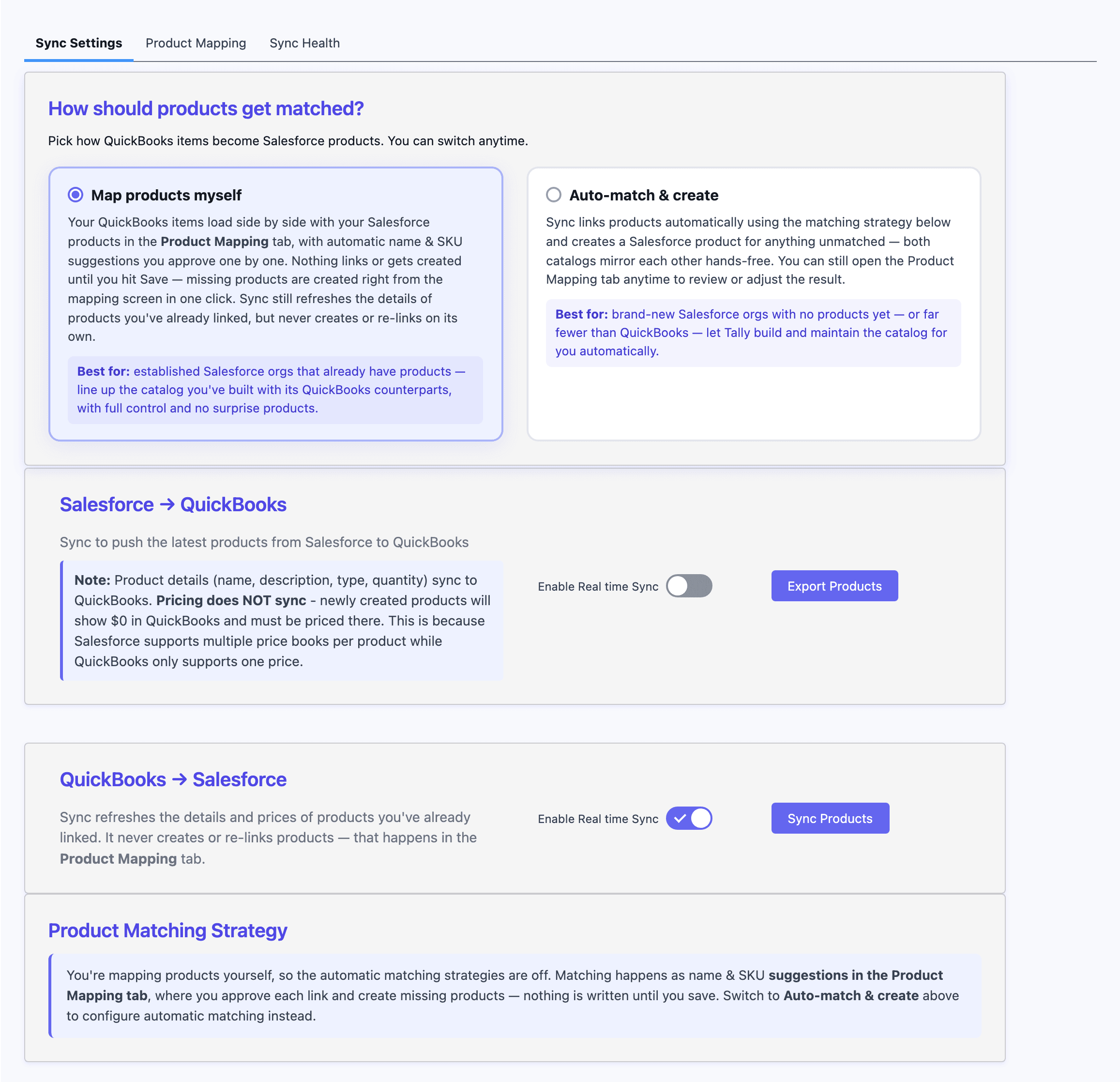
    A new choice at the top of Sync Settings. “Map products myself” is built for established Salesforce orgs that already have a product catalog: your QuickBooks items load side by side with automatic suggestions, and sync never creates or re-links a product on its own. “Auto-match & create” is for brand-new orgs with no products yet (or far fewer than QuickBooks) — Tally builds and maintains the Salesforce catalog automatically using your matching strategy. Switch anytime; the settings page reshapes itself around your choice.

    salesforce.com/lightning/tally
    Sync Settings with the new mapping-mode choice: map products myself, or auto-match and create
  • Smart match suggestions — you approve every one

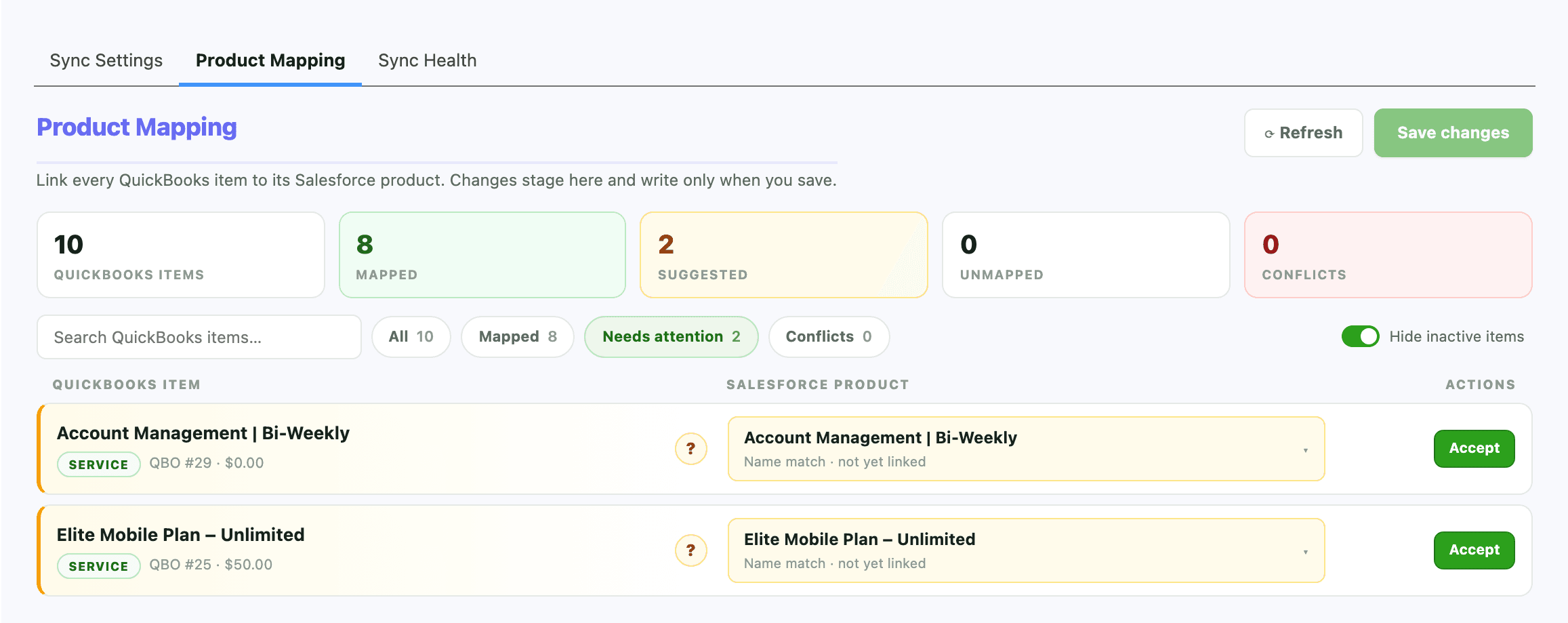
    When a QuickBooks item and an unlinked Salesforce product share a name or SKU, Tally pre-fills the match in amber and waits for you. One click on Accept links them. Nothing is ever linked behind your back, so a coincidental name can never quietly merge the wrong products.

    salesforce.com/lightning/tally
    Suggested matches highlighted in amber, each waiting for one-click approval
  • Search-as-you-type linking, with guardrails

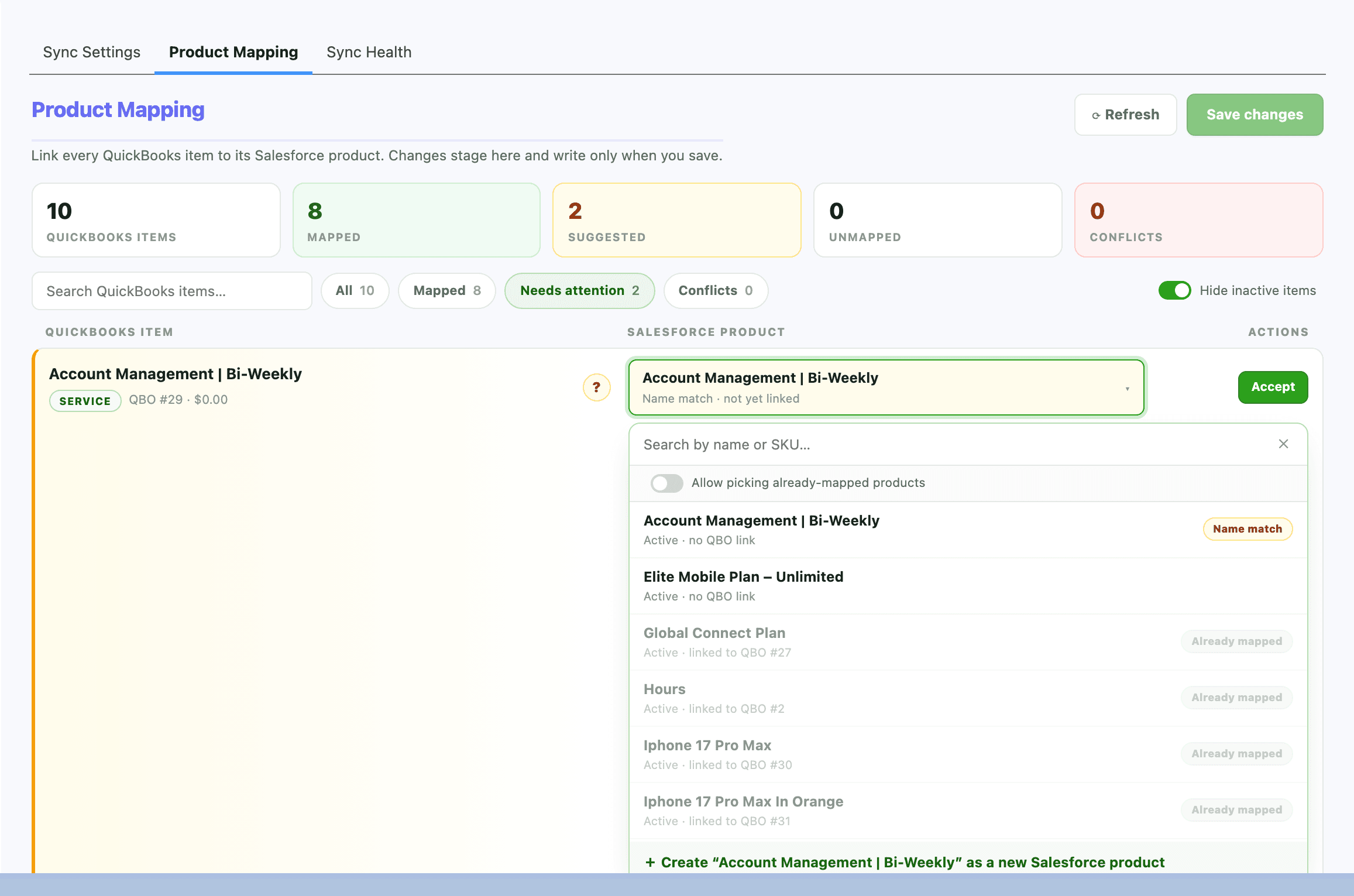
    Open any row and search your Salesforce catalog by name or SKU. Every result shows its link status before you pick, and products already linked to another QuickBooks item appear disabled with the reason — you always know why an option is off the table. And when sharing is the point, a deliberate override toggle unlocks those options and spells out exactly what will happen — for example, that two Salesforce products will now sell the same QuickBooks item — before anything saves.

    salesforce.com/lightning/tally
    Searching Salesforce products from a mapping row, with already-linked products disabled
  • One click when the product doesn't exist yet

    QuickBooks has an item Salesforce doesn't? No pre-sync required — your QuickBooks catalog is already loaded on screen, so Create in SF stages the product from those details (name, SKU, type, price) and builds it when you save, with the QuickBooks link stamped from the very first moment. No half-created products, no cleanup pass later.

    Learn more
  • Conflict detection and cleanup

    If two Salesforce products ever ended up linked to the same QuickBooks item, the row turns red and shows every claimant. Pick the one that should win and Tally unlinks the rest — dirty data you may not have known you had, resolved in seconds.

  • Nothing saves until you say so

    Edits stage on screen with a running count on the Save button, then write in one batch. Every row reports back individually — successes turn green in place, failures show the reason in plain English right on the row. And if a sync job changed a mapping while you worked, Tally rejects just that row instead of silently overwriting it.

  • A cleaner Sync Products page

    Sync Products is now organized into three tabs — Sync Settings up front, with Product Mapping and Sync Health one click away — so setup, mapping, and monitoring each get a full page instead of sharing one long scroll.

v3.86

Spring 2026

· July 2026

Payments collected anywhere, a purchase order builder that has your back, and a product catalog that keeps itself honest — plus plain-English error messages across the whole app.

Install v3.86 Installs from Salesforce · AppExchange managed package
salesforce.com/lightning/tally
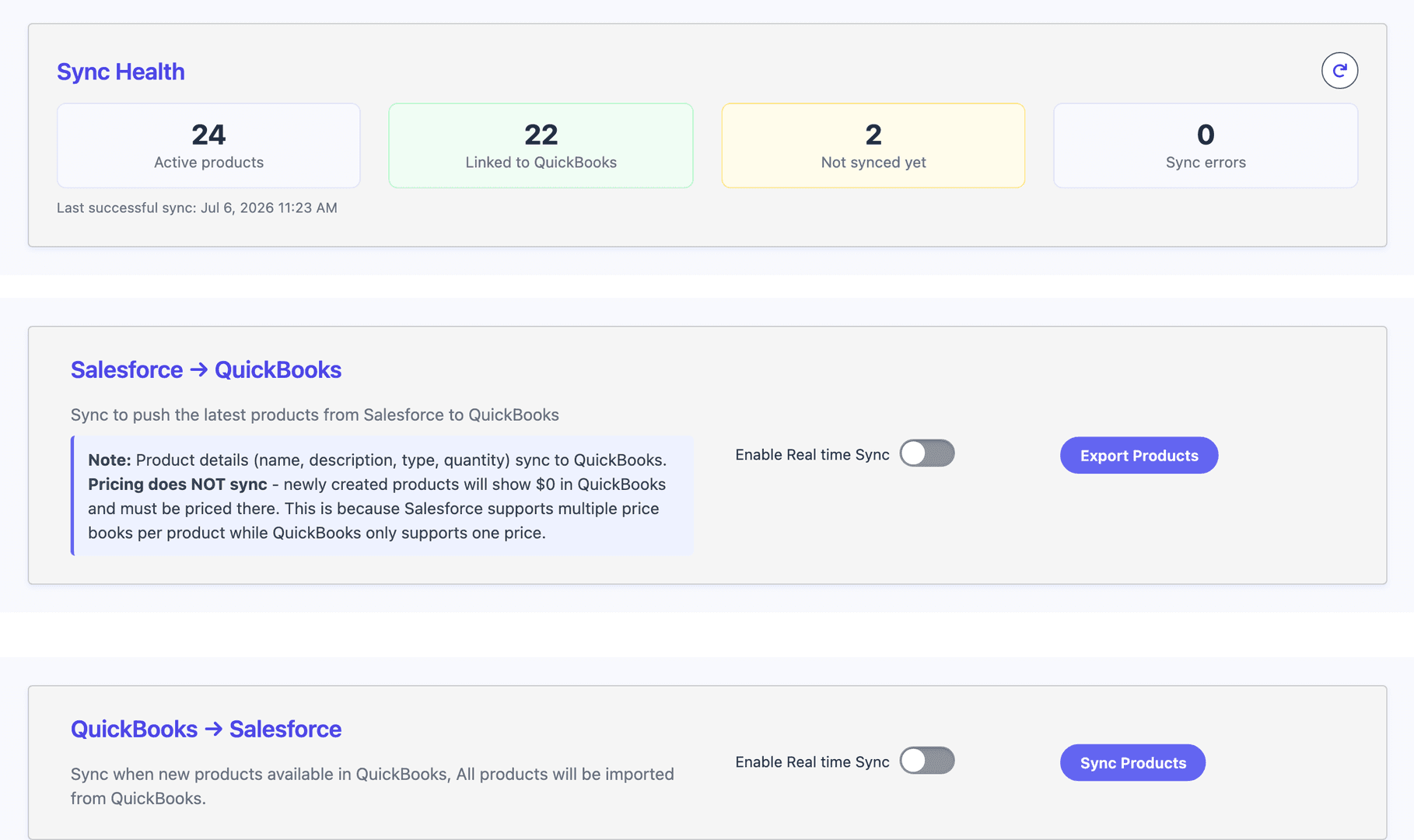
The new Sync Health dashboard in the Tally Hub
  • Record cash, check & wire payments

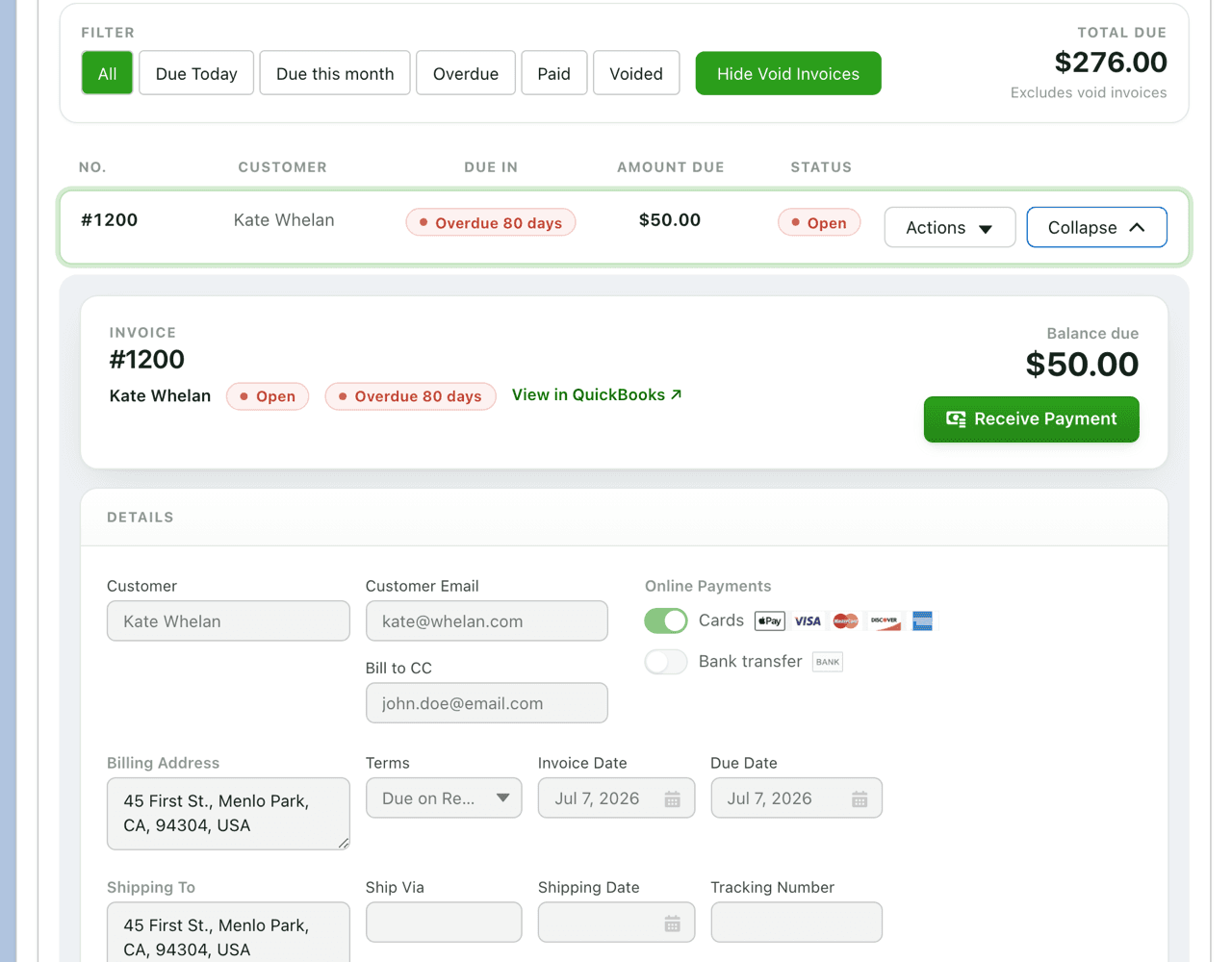
    The Receive Payment modal gained a Cash / Check / Other option: pick a payment method straight from your QuickBooks company, stamp the date and check number, and the invoice flips to Paid in both systems — nothing is charged.

    Learn more
  • New Flow action: Record Payment on Existing QBO Invoice

    Automate full or partial payments with the method and reference stamped in both systems. Bulk-safe by design — one Flow run can record payments across hundreds of invoices — and overpayments are rejected instead of stranding credits in QuickBooks.

    Learn more
  • Product Sync Health dashboard

    The Tally Hub now shows your catalog's health at a glance — linked, pending, and failed counts with last-sync time. Every failed product carries the reason in plain English and what to do about it.

    Learn more
  • Product sync, hardened

    Full pagination for catalogs beyond 1,000 items, fractional quantities, automatic deactivation when items retire in QuickBooks, and bulk-safe exports that don't trip platform limits.

    Learn more
  • Purchase orders that validate before they send

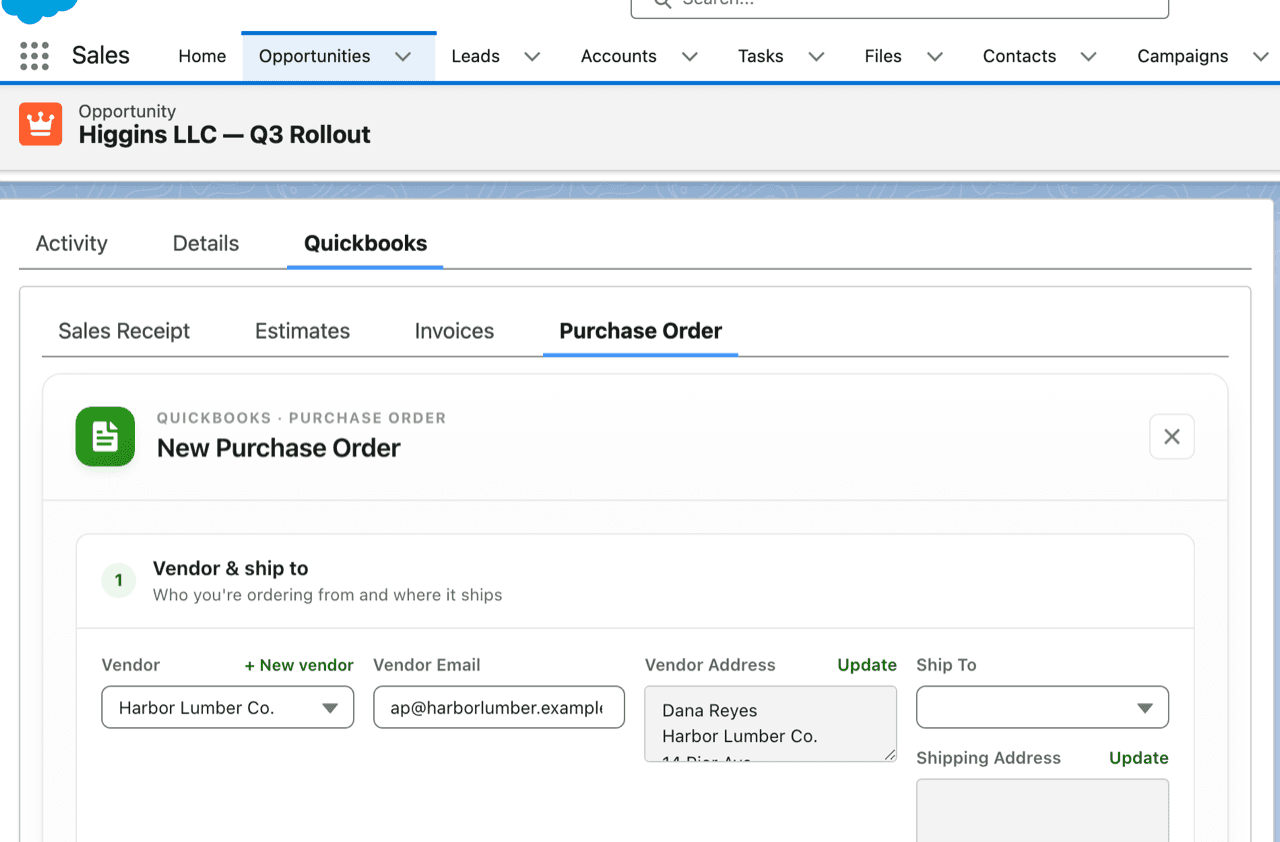
    The builder catches a missing vendor, empty lines, or a missing vendor email before anything leaves Salesforce — and Save and Send now emails the vendor every time, attachments or not.

    Learn more
  • Errors that tell you what to do

    When QuickBooks rejects something — an inactive customer, an expired connection, a duplicate document number, closed books — Tally now shows the real reason and the fix, everywhere: invoices, payments, purchase orders, and product sync.

Want these features in your org?

QuickBooks updates roll out through the AppExchange. Book a demo and we'll walk you through what's new.